Tourism Sustainability Toolkit
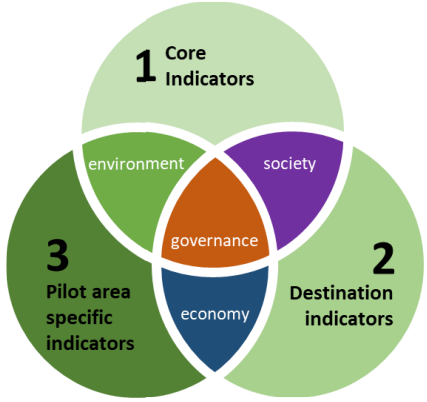
The Tourism Sustainability Toolkit aims at establishing monitoring and evaluation schemes in order to measure the impacts of tourism in relation to the economy, society, the environment and governance. The toolkit addresses the challenge of adapting existing indicators schemes to the particularities of the destinations under assessment. It provides a framework that measures and monitors sustainability at the local level by introducing a three-tier system of indicators. The toolkit manages to incorporate different types of tourism activities as well as special characteristics of coastal tourist destinations in the Mediterranean while allowing for comparisons among them.
 click to view full size
 Implementation
The toolkit addresses five types of coastal tourist destinations which have been identified as critical in the case of the Mediterranean: beach/maritime destinations, urban/cultural, cruising, recreational boating and nature/ecotourism destinations. It was tested in 11 pilot sites which selected indicators based on key priorities for tourism sustainability, the dominant types of tourism activity and area-specific issues related to critical particularities for the sustainability of the destination. The process resulted in 11 sets of sustainability indicators as in the case of Alexandroupoli-Makri where a customized toolkit of 17 indicators was developed.
Replicability conditions
Due to the lack of available data at the destination level, the engagement of local stakeholders is imperative for the effective implementation of the toolkit. Stakeholders with diversified background –policy makers, technical and administrative authorities, scientific experts, universities – need to be engaged in order to ensure the reliability of the selected set of indicators and the stakeholders’ commitment in the measuring and monitoring process. Their responsiveness will frame the indicators selection time. Workshops can simplify and speed up the process. The time needed for measuring depends on the number of selected indicators and the available data. Since sustainability is an ongoing process, it needs to be measured periodically to monitor the advancements at the destination level. Staff costs may be needed but no technical costs are required. The software for the toolkit with user guidelines is provided by CO-EVOLVE project and requires minimum training.