Integrated model of sustainable tourism in small towns
The theoretical framework aims to ensure a common understanding of sustainable tourism and the theoretical paradigms on which to base a sustainable tourism planning methodology. Tourism has significant social, economic, and environmental effects and has an enormous potential to progress across the Sustainable Development Goals (SDGs). If well supervised, the tourism industry can build quality jobs, reduce poverty, and provide incentives to conserve the environment, helping to shift to more inclusive and resilient economies.
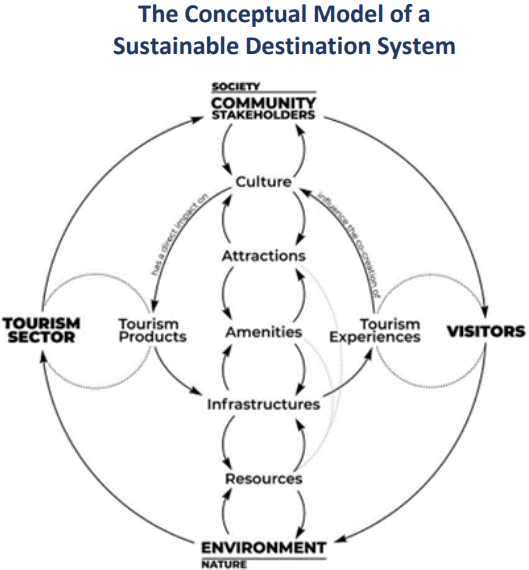 click to view full size
 Implementation
The framework is a tool to help policymakers in planning and managing sustainable tourism development. It is a framework that unequivocally describes the concept of sustainability in tourism policy. Despite its critical relevance, sustainability is slowly being integrated into mainstream tourism policy making. Many policies, in fact, still focus on economic growth as a leading role. The implementation of this framework is closely connected to ‘cynefin framework’, ‘complexity science’ and ‘wicked problems’. A coherent framework that can implement changes outside institutions, and also in the private sector, is one that is holistic. It involves the implementation of conceptual pillars and phases: A) Destination in practice: conceptualizing a destination as the fundamental unit of analysis in tourism, through Destination Management Organizations, B) Establishing a common framework based on the TQM Methodology, with precise pillars and dimensions for sustainability, with a bottom-up participative approach, C) Developing coherent policies and instruments, including governance, regulative, financial and advocative tools.
Policy Hubs
Target Groups
Replicability conditions
Based on the Total Quality Management (TQM) methodology, this framework follows a systematic structure which can be analysed and assessed through a series of questions developed under each pillar of sustainable development and its related dimensions. Weaknesses and gaps can be identified, and possible actions considered through the use of available instruments. There are many obstacles to the implementation of sustainable tourism policies. The difficulty of successfully implementing policies is not technical, but involves political, cultural, economic and social changes. Sustainable tourism policy is complex because it inevitably interacts with other policies. In order to support replicability, this framework promotes coordination to reduce the gap between policy development and implementation.