Local planning manual for sustainable tourism rejuvenation of small, fascinating Mediterranean towns
SuSTowns methodology seeks to develop tools for the planning and management of tourism in order to prevent its decline in small, fascinating Mediterranean towns by promoting sustainable and quality tourism. By making use of existing tools and applying the most innovative total quality management techniques to public policies (Total Quality Management Methodology), the project promtes participatory planning and promotional processes for small, fascinating Mediterranean towns, based on the principle of sustainability and the enhancement of local cultural heritage. The tool focuses specifically on a local-planning methodology that can promote rejuvenation for those destinations facing decline.
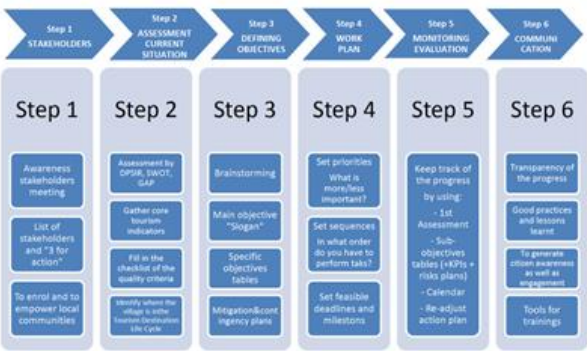 click to view full size
 Implementation
The tool is a guide to the application of the TQM (Total Quality Management) approach in the management and governance of sustainable tourism in the small and fascinating villages of the Mediterranean. The way to use this methodology is simple:
a) Read the common theoretical framework to have a common understanding of sustainable tourism (section 2);
b) Know the importance of stakeholders, who they should be and what role they will have (section 3 and Step 1);
c) Follow the steps to develop the action plan (Step 2, Step 3 and Step 4);
d) Understand the need to monitor the implementation of the plan (Step 5) to continuously improve the impact of the actions;
e) Communicate with stakeholders and project partners (Step 6).
At the end of the methodology there is a checklist of the minimum content that the action plan should include. Once the methodology is applied, an action plan will be produced that promotes sustainable and quality tourism, which is the main document to follow in order to address the (tourist) decline of the villages.
Policy Hubs
Target Groups
Replicability conditions
This methodology aims to serve as a useful tool, not just for the pilot municipalities of the SuSTowns project, but also for all local entities and other stakeholders interested in managing (in the broadest sense: strategic planning, governing, etc.) a tourist destination with a strategic long-term vision capable of identifying risks and signs of decline and implementing measures for the rejuvenation of said destination. In this sense, the methodology is intended to be easily replicable, particularly within small, fascinating Mediterranean towns. Based on the pilot experiences, various learnings are systematised and incorporated into the methodology, with much broader target groups: local authorities of small Mediterranean tourist centers; regional and national authorities who wish to promote strategic management of tourism in small towns; and tourism experts who advise local authorities in the management of sustainable tourism.