Replication toolkit
The INCIRCLE replication toolkit supports the transformation of the tourism sector according to the principles of circular economy (reduce, regenerate, rethink, innovate, revalue) directly addressing the management and efficiency of finite natural resources in MED destinations. The toolkit rests on a 7 step methodology guiding tourist policy makers through all policy development stages, from agenda setting to policy evaluation, in an integrated perspective. The toolkit is composed of a set of specific tools, fully aligned to the INCIRCLE methodology, as follows: Operational Model Toolkit, Participatory Process Toolkit, Strategy Evaluation Toolkit, Summary of Strategies, Summary of Circularity Indicators and Policy Brief.
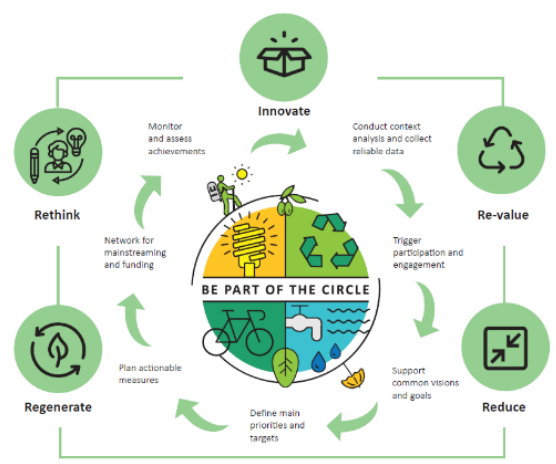 click to view full size
 Implementation
The replication toolkit was tested in 6 MED vulnerable destinations, such as islands and scarcely inhabited territories, to check its transferability and versatility as well as the efficiency of its tools in terms of incorporation of critical sustainability and circularity aspects in MED destination management. The testing of the INCIRCLE toolkit in replicating territories gave birth to:
- 6 circular tourism strategies, containing an overall of 132 devised measures to improve tourism policy making in terms of protection and valorisation of already scarce and finite natural resources
- the engagement of more than 180 territorial stakeholders in order to promote participatory and collaborative approaches for circular tourism, establishing a critical mass for a sustainable and circular development in the Mediterranean
View related best practice
Replicability conditions
The INCIRCLE replication toolkit is devised as an easy adaptable tool, able to be tailored to different MED territories needs and features. The toolkit is available in all MED languages to foster its application in all MED destinations. The only prerequisite for its application by MED tourism policy makers is the will to trigger collaborative partnerships at different levels such as public-private cooperation initiatives and the inclusion and engagement of a wider range of stakeholders in the policy development process, fully applying a quadruple-helix approach to tourism planning, management, monitoring and evaluation.