MED-GIAHS Network
The MED‑GIAHS Network aims to preserve, promote, and sustainably develop Mediterranean Globally Important Agricultural Heritage Systems by creating a shared space for cooperation, mutual learning, and territorial collaboration. It responds to common threats such as climate change, depopulation, biodiversity loss, and erosion of traditional knowledge, while fostering sustainable tourism that strengthens local livelihoods and cultural and environmental heritage. The network provides a framework for exchanging experiences, developing joint methodologies and tools, and supporting recognized, candidates, and potential GIAHS sites in enhancing dynamic conservation and contributing to resilient rural development.
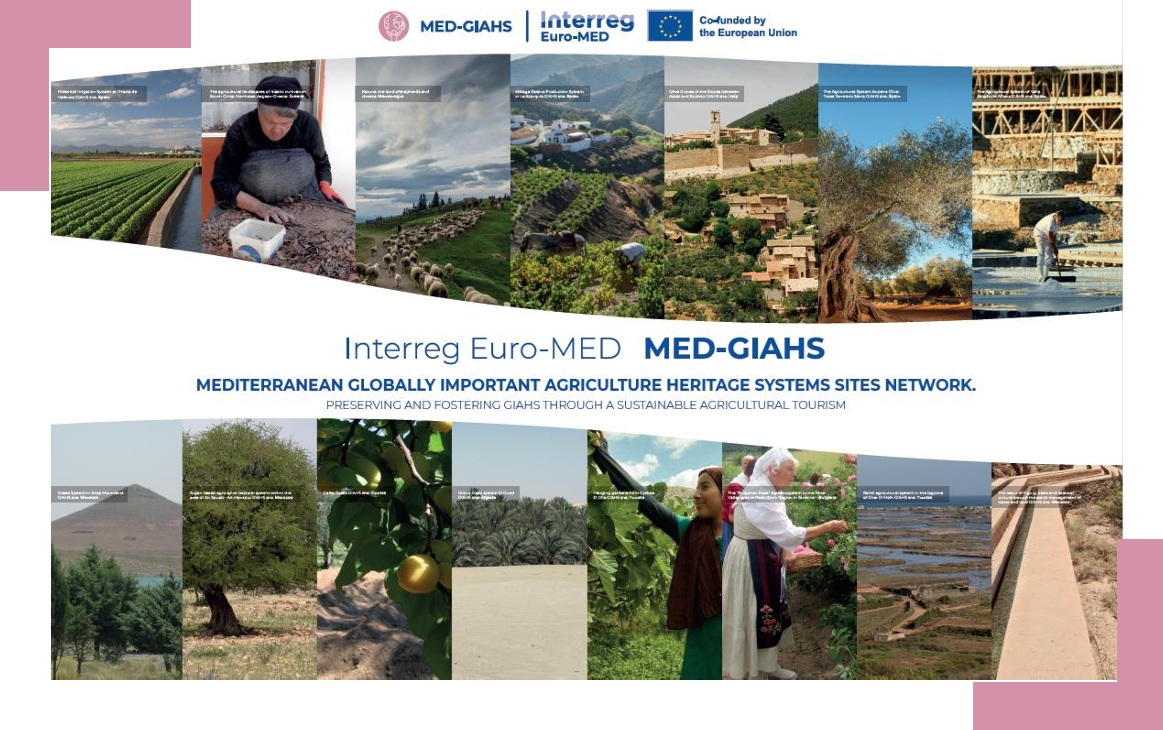 click to view full size
 Implementation
The network functions as a shared platform for exchanging experiences, methodologies, and solutions related to agricultural heritage systems, sustainable tourism, and rural development. Through its strategic lines, objectives, and coordinated activities, it enables territories to address common threats—such as climate change, depopulation, biodiversity loss, and erosion of traditional knowledge—while enhancing their capacity to promote sustainable tourism and reinforcing the cultural and environmental value of GIAHS landscapes.
Together with the MED GIAHS project pilot areas listed in the “Pilot Areas” section, the following recognized GIAHS sites (more information about them can be found online in the FAO GIAHS Programme website) and Potential Candidates, have also subscribed the MED GIAHS Network:
GIAHS sites
· Spain – The Agricultural System of Valle Salado de Añana
· Spain – The Agricultural System Ancient Olive Trees Territorio Sénia
· Morocco – Argan-based agro-sylvo-pastoral system within Ait Souab – Ait Mansour
· Morocco – The ksour of Figuig: oasis and pastoral culture
· Morocco – Oases System in Atlas Mountains
· Tunisia – Hanging gardens from Djebba El Olia
· Tunisia – Ramli agricultural system in Ghar El Melh
· Tunisia – Gafsa Oases
· Algeria – Ghout Oasis system El Oued
Potential candidates GIAHS sites
· Algeria – Fogarra of Adrar and Timimoun, water management system in Central Sahara
· Spain – Salt-making and aquaculture production system of the Bay of Cádiz estuaries
The MED GIAHS Network will serve as a working place for new recognized GIAHS sites and candidates in the Mediterranean area, to serve as a meeting point for the development of these unique World Agricultural Heritage.
Policy Hubs
Target Groups
Replicability conditions
Replicability depends on the ability of territories to internalize the network’s cooperative principles, align them with local governance arrangements, and participate in shared learning processes. Effective transfer requires openness to knowledge exchange, commitment to dynamic conservation, and the capacity to adapt the network’s strategic framework to diverse socio‑ecological contexts. Replication is further supported when territories can integrate sustainable tourism, agricultural heritage preservation, and community‑based development into coherent strategies, ensuring continuity with the network’s objectives and contributing to broader Mediterranean cooperation